
Imagine Housing Soft Sites Analysis
Imagine Housing
HR&A conducted a comprehensive evaluation for Imagine Housing analyzing the impacts of Bellevue, Washington’s C-1 zoning overlay, which provides density bonuses for affordable housing development on nonprofit, religious, and public land. Following the legislative changes, Imagine Housing, a nonprofit affordable housing developer, sought to understand the impacts of the C-1 overlay district on affordable housing production in Bellevue and the potential scale of new home production if it were to be taken up by other Eastside communities. Through market analysis, parcel identification, and financial feasibility modeling, HR&A created development scenarios for prototypical sites and recommended strategies to leverage innovative funding sources. This work provided Imagine Housing with actionable insights to expand affordable housing production across Eastside communities.

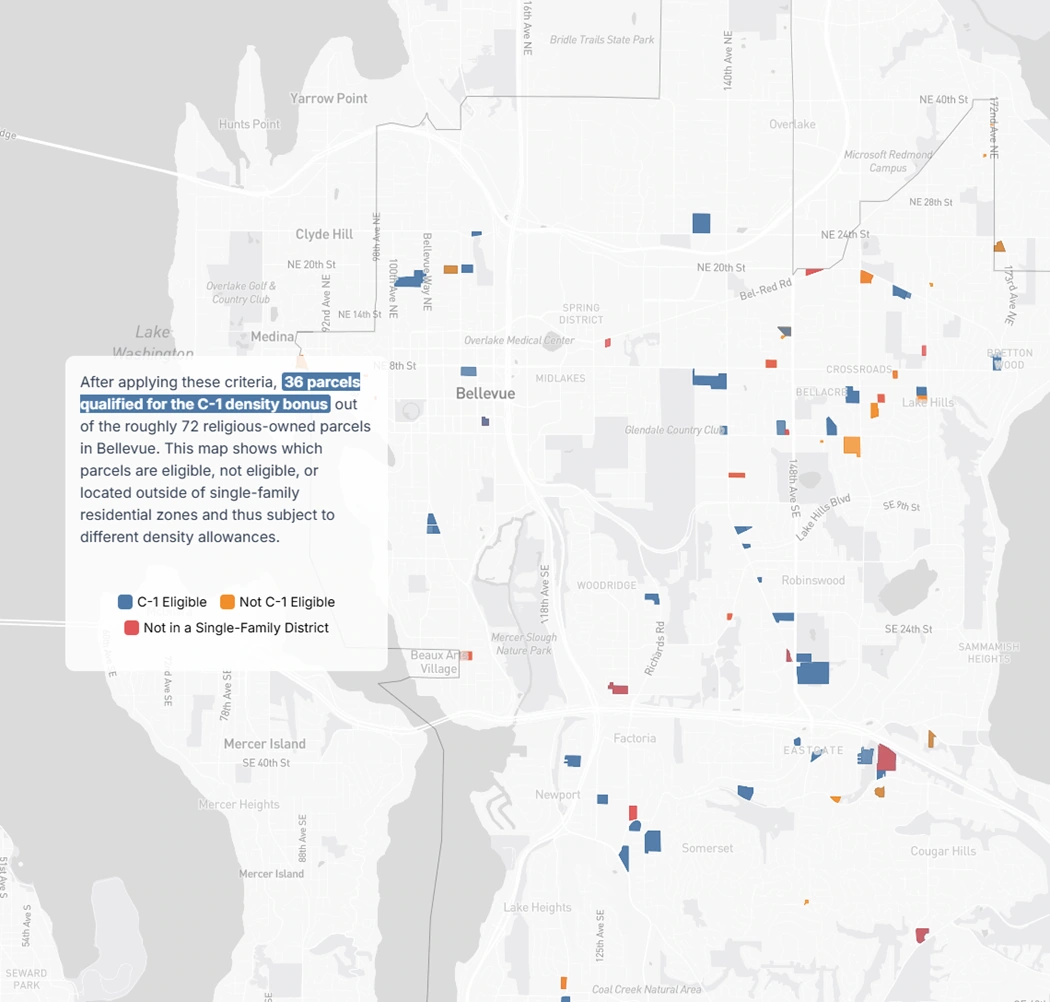
Understanding the C-1 zoning overlay’s potential required systematic analysis of both regulatory opportunities and market realities across Bellevue and neighboring Eastside communities. HR&A developed a comprehensive research approach that examined the zoning ordinance’s specific provisions, analyzed land ownership patterns among religious denominations and nonprofit organizations, and assessed rental housing market conditions to identify development opportunities. With this integrated analysis in hand, HR&A could evaluate the overlay’s practical application and the potential to scale affordable housing development in the region’s competitive real estate environment.
HR&A’s analysis provided Imagine Housing with concrete development scenarios and financial feasibility assessments for actionable sites, demonstrating how the uptake of similar overlays in other Eastside communities could help create affordable housing opportunities. The evaluation identified viable parcels and recommended strategies for combining zoning benefits with innovative funding sources to maximize development potential. The analysis ultimately supports increased affordable housing production in one of the region’s most expensive markets, helping address critical housing needs while providing a replicable model for policy innovation throughout the region.