
Insights
We provide objective assessments and analyses that help clients make forward-thinking, strategic decisions that drive projects forward. Offerings include public policy analysis, market and financial feasibility for public and private investments, and economic and fiscal impact analysis.
We’re excited to share a newly published white paper from the Lincoln Institute of Land Policy, co-authored by HR&A Senior Principal Ignacio Montojo, Senior Analyst Harman Singh Dhodi, and Juan Sebastián Moreno. This study examines how six Colombian cities use tools that allow local governments to participate in property value increases following public investments like roads or transit, to support new and existing public services and infrastructure.

Today, those same institutions are under pressure from every direction. Public funding remains uncertain. Enrollment costs are rising. Land values around many campuses are climbing faster than HBCUs can capitalize on them. In cities across the country, the neighborhoods HBCUs helped stabilize and shape are now targets of speculative development. That presents both financial and cultural uncertainty. Without intention, we risk watching history repeat itself as Black institutions are surrounded, displaced, or disconnected from the communities they were built to serve.
Millennials — Americans born between the early 1980s and late ’90s — are about to become the nation’s wealthiest generation. Estimates of assets that will move from baby boomers to millennials over the next two decades range from $84 trillion to $124 trillion, a transformation that will have a profound impact on how cities look and function.

Last week, HR&A’s Andrea Batista Schlesinger joined mayors from across the country at the Mayors Innovation Project winter meeting—a gathering that served as both an antidote to the current moment and a reminder of the real, tangible work happening in cities across America.

For too long, the office has been shaped by rigid zoning laws, inflexible lease structures and outdated underwriting standards. These frameworks were designed for a world where work meant sitting in an office from 9 to 5, five days a week.
Rural healthcare in America is at a pivotal moment. Earlier this year, the Centers for Medicare & Medicaid Services launched the multibillion-dollar Rural Health Transformation Program — one of the most significant federal investments in rural care delivery in decades. In a new Route Fifty op-ed, Principal Shawn Daugherty argues that its success depends on something often overlooked: reliable, affordable high-speed broadband.
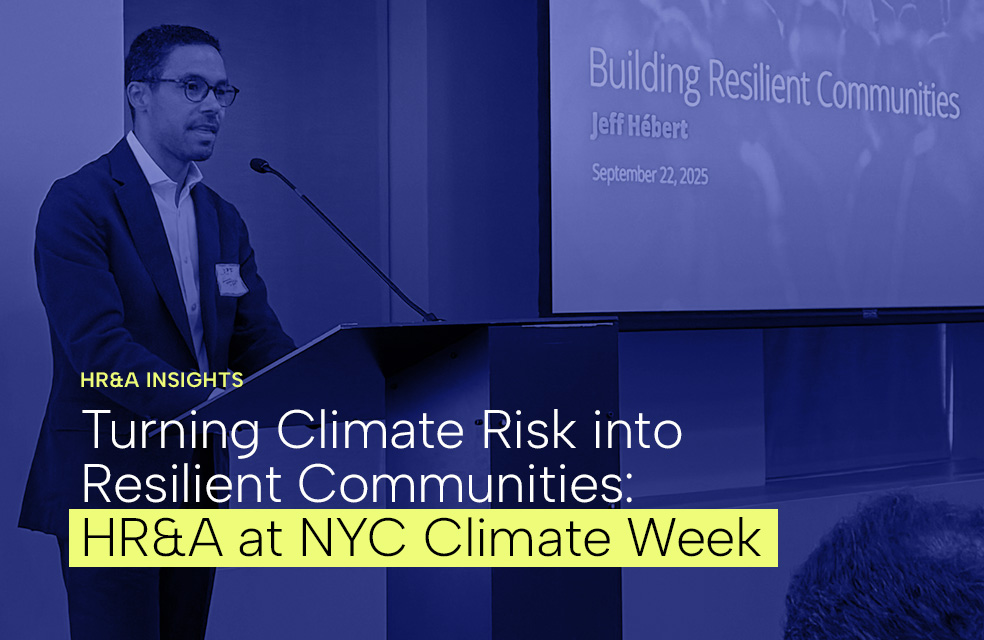
In celebration of NYC Climate Week, HR&A CEO Jeff Hébert joined the Adaptation Forum, hosted by The Resiliency Company, for a lightning talk alongside Daniel Kaniewski of Marsh McLennan and Janika McFeely of JLL to explore the question: how do we turn climate risk into resilient communities? The discussion underscored the urgent need to move beyond understanding risk toward building resilience in ways that strengthen communities, markets, and infrastructure.

The City of Yes for Housing Opportunity is a sweeping zoning reform aimed at tackling New York City’s housing crisis. Approved by the City Council on December 5, 2024, the initiative aims to enable more housing in every neighborhood by increasing allowances, flexibility, and incentives for diverse and affordable housing types, while reducing regulatory hurdles for development and conversions. The City estimates that over 80,000 units will be created through these changes.
Leaders of HR&A’s Digital Opportunity team recently attended the Net Inclusion conference at the Gila River Indian Community with a clear purpose: to connect with practitioners and organizations who are grounded in community, geared for action, and committed to closing the digital divide.
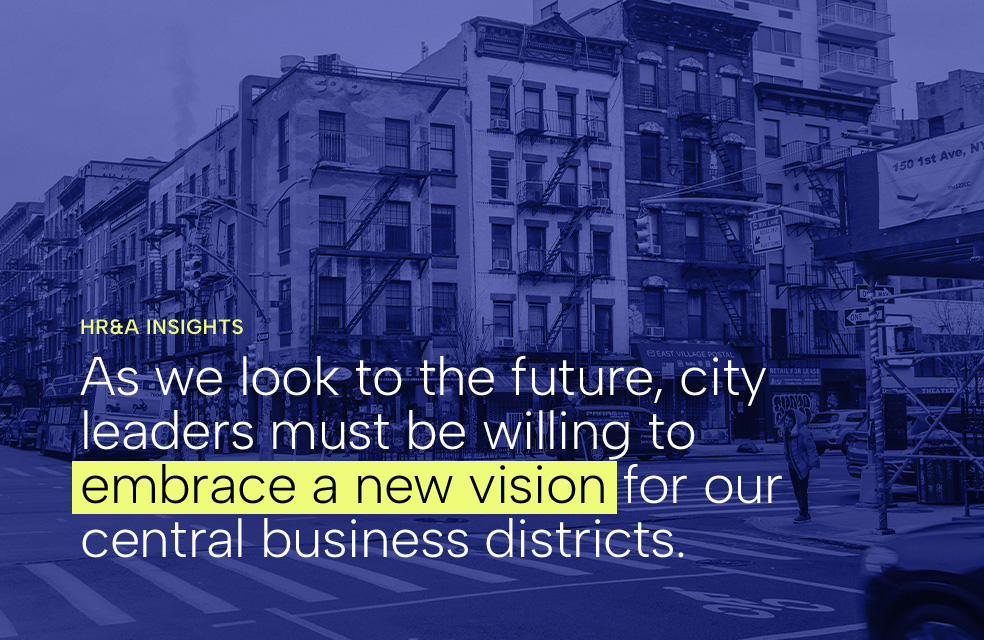
Take a walk down nearly any street in Lower Manhattan, and you’ll see a startling number of vacant storefronts. One out of every four floor-level retail spaces sits empty. Walking these streets can feel eerie and disjointed — part of a broader shift in our city’s street life that occurred gradually over time and accelerated following the pandemic. Manhattan’s business districts are particularly troubled.
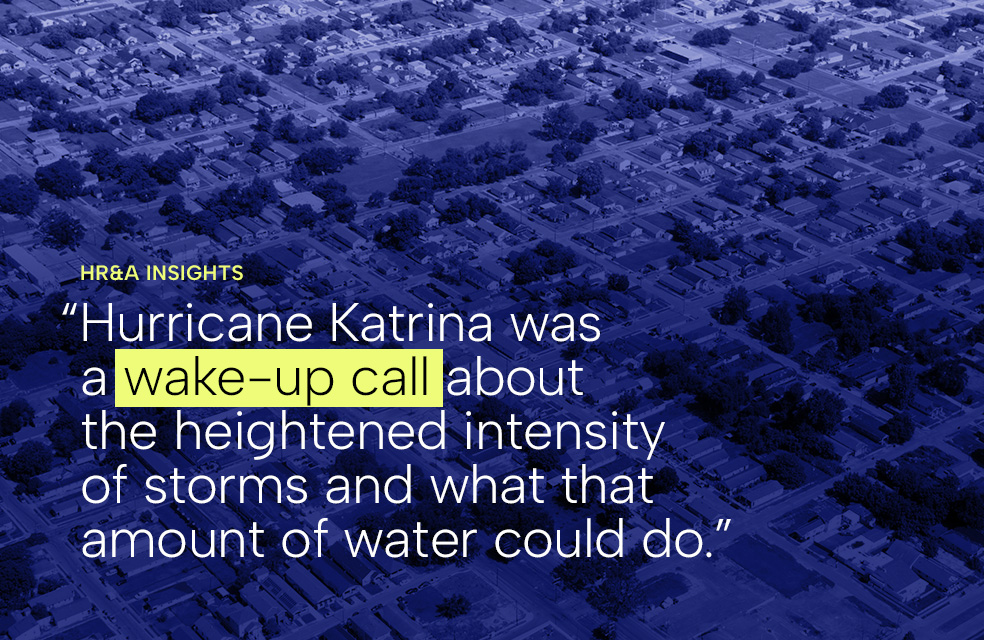
HR&A Advisors CEO Jeff Hébert, who served as New Orleans’ first Chief Resilience Officer from 2012 to 2017, shared his thoughts in this recent Smart Cities Dive article, which traces New Orleans’ centuries-long battle against flooding and hurricanes, from its first levees in the 1700s to today’s multi-billion-dollar storm protection systems. Nearly 20 years after Hurricane Katrina, New Orleans continues to grapple with the challenges of climate change, sea level rise, and subsidence.
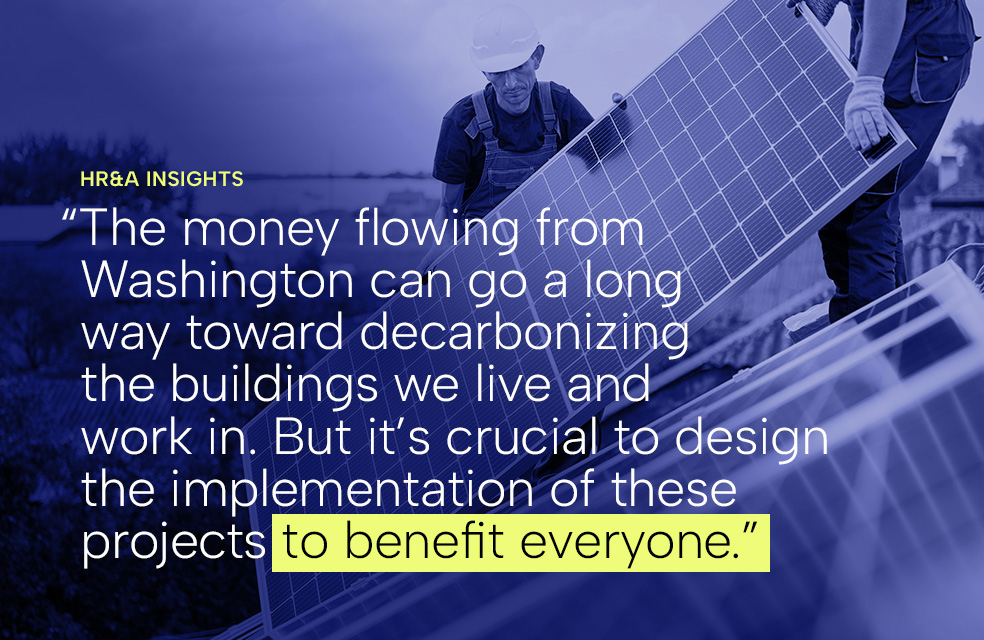
The Bipartisan Infrastructure Law and the Inflation Reduction Act will collectively invest tens of billions of dollars in our infrastructure and buildings. While the spending generated by these two federal laws will improve transportation, broadband and air quality while creating new industries around the country, perhaps the most concrete change for many of us will be related to the carbon footprint of the places where we live, work and spend our leisure time.
The financial system in Philadelphia is failing its residents. Almost a quarter of Philadelphia’s population lives below the poverty line, with 1 in 10 living in deep poverty, and more residents are unbanked or underbanked than in any other major U.S. city. Philadelphians have identified a strong potential solution: creating a municipal public bank to address historic inequities in providing access to quality banking and financial services.

As cities face growing climate risks, what does long-term adaptation really look like? HR&A CEO Jeff Hébert joined Ten Across to discuss community recovery and resilience on the 20th anniversary of Hurricane Katrina.
The economic impacts of the COVID-19 pandemic have exacerbated pre-existing housing affordability challenges and will lead to an eviction crisis on a scale never before seen. In the face of this crisis, Wake County, North Carolina, recently announced the House Wake! COVID-19 Eviction Prevention Program following an in-depth study of housing needs by HR&A. The program offers a model for other state and local governments seeking to keep low- and moderate-income renters in their homes and to stretch limited public dollars.
Like many large institutions across the country, New York City’s Montefiore Einstein Hospital and medical school has functioned as a community anchor for decades, providing employment, education, and vital healthcare services for residents of the Bronx. At the same time, the physical setting of the institution’s Morris Park campus – disconnected from the surrounding neighborhood, with unclear boundaries and branding and no existing transit link – has also limited its potential as a community asset and a true regional hub. Could a more integrated planning approach help close these gaps and offer lessons for other sites and cities?
We’re thrilled to see Hannah Glosser, Director at HR&A Advisors, was featured in SmartCitiesDive for her insights during the Urban Land Institute’s Resilience Summit. In the article “Reimagining ‘Managed Retreat’ in a New Reality,” Hannah discusses the increasingly urgent, and complex, issue of managed retreat in the face of climate change.
Colleges and universities serve as economic anchors of their communities. This is especially true in small and mid-sized cities where universities are frequently the largest local employers and a primary source of young and ethnically diverse residents. As higher education institutions face demographic and financial challenges due to pre- and post-pandemic trends, they can bolster their surrounding communities – and support their long-term viability – by investing in neighborhood improvements and economic opportunity for local residents.
Change is a natural phenomenon in any neighborhood – families move in and out, businesses come and go, new immigrant groups bring different languages, cultures, and cuisines. When rents begin to grow faster than the incomes of residents, however, the resulting economic pressure can force people from their homes before they are ready to leave. The result is displacement that harms individuals, families, schools, and communities.
This spring, the City Council will vote on Mayor Eric Adams’ City of Yes for Economic Opportunity proposal – an important step for solving the myriad real estate challenges that small businesses face in a changing economy. It brings about long overdue changes to zoning created over 60 years ago by city planners who could not have conceived of how – and where – our city’s economy operates today. As the Department of City Planning describes it, this proposal will “allow more types of businesses in more places” and remove barriers to growth.
In New York City, top-quality office space is coming online despite challenging economic conditions. The ongoing “flight to quality” for commercial office space across the country is no secret, with companies of all sizes flocking to recently redeveloped or newly built buildings with unique, enticing amenities. As larger companies embrace hybrid work models and seek a more boutique office experience, smaller creative tenants in the 10,000- to 30,000-square-foot range now make up the most active segment of the market. According to CoStar, about 65% of leases signed in early 2023 were for space commitments of less than 15,000 square feet.
City leaders are being called upon to use the power they have to make systemic changes. One power examined far too infrequently comes in the form of the billions of dollars that flow through city coffers and then through the commercial banks that manage local government transactions. The actions of commercial banks shape cities and their economies more than any mayor’s economic development policy. Historically, these actions have reinforced White ownership and Black poverty.
Written by Danny Fuchs, Youssef Kalad, and Raquel Vazquez
We have been wondering how the diversity of cities in which we work are innovating and adapting to the new reality of hybrid work. Specifically, we were curious if the civic leaders with whom we’ve worked on downtown revitalization in some parts of the country had lessons to share with their counterparts in other regions. Below, we invite you to read responses from nine private developers, city officials, business improvement district heads, and other civic leaders.
Following a challenging election season, the Biden-Harris transition team is now drawing up plans for their policy agenda. Their task is hardly enviable. As we enter 2021, the United States faces four epochal crises: a public health emergency, an economic downturn, climate change, and a reckoning with systemic racism. Addressing these challenges will require a new approach to investing in our communities that stimulates more diverse economic growth, promotes social equity, and taps into knowledge creation that solves, rather than compounds, our twin health and environmental crises.
Experts have been arguing for some time that we are in the midst of the fourth industrial revolution, with technology driving change at an unprecedented rate. Among the important changes coming is a shift from a fossil-fueled economy to a green one. As with previous transformations, the beneficiaries of that change are uncertain. The decisions we make in the next few years will determine how quickly we build this economy and who enjoys the benefits of this new system.
The $973 billion Infrastructure Investment and Jobs Act (IIJA), signed into law last year, represents the largest investment in national infrastructure in decades. Before cities, counties, and states can access these funds and leverage any additional public or private funding, they must differentiate their visions, competing with exemplary projects from every corner of the country.
On May 25, the City of San Jose’s elected leaders unanimously approved a Google plan to build an 80-acre mixed use district between the city’s Diridon Station multi-modal hub and Downtown. The project began with a 2017 Google announcement of the project’s intent that was then discussed and negotiated by a diverse set of community leaders working with Google over the course of four years. By the terms of the resulting Development Agreement, what is now known as Downtown West will, when built out, include up to 7.3 million square feet of office, 4,000 homes, retail, hotels, community amenities, and up to 15 acres of parks and open space. It will bring more than 30,000 tech jobs to San Jose.
As American cities grapple with persistently high office vacancies and an escalating housing crisis, a new report provides critical insights into the potential for converting office buildings into residential spaces. “Understanding Office-to-Residential Conversion: Lessons from Six U.S. Case Studies” examines conversion activity in Houston, Los Angeles, Pittsburgh, St. Louis, Stamford, and Winston-Salem, offering a roadmap for policymakers and developers navigating this complex process.
In late January, Mayor Adams announced a bold and exciting goal to require New York City’s for-hire vehicle fleet to reach zero emissions by 2030. This was a welcome step forward, considering the goal is shared by major for-hire platforms, including Uber, as well as the City Department of Transportation, who recognize the climate crisis is an existential threat to our city and our planet.
Bold investments to strengthen New York City’s civic infrastructure are key to a more equitable future and to meet the scale of the challenges we face as a city.
Universal high speed internet access is foundational to addressing American inequality, particularly in education, employment, and healthcare. Nearly every effort to address inequality relies in some way on the internet. Yet more than 18 million American households live without a broadband subscription, 13.9 million of them in metro areas. In urban counties, people of color represent 75% of all unconnected residents.
The impact of the COVID-19 crisis on municipal fiscal health will be extraordinary. With large portions of municipal expenditures mandated by state or federal law, discretionary spending will be highly constrained, and agencies that rely on unrestricted funds – fire, police, sanitation, schools, and parks – will be competing to establish the essential nature of their services. Historically, park systems have fared poorly in these competitions, and preliminary municipal budgets from around the country suggest that this crisis will prove no different, absent effective advocacy.
Transportation agencies are typically incentivized to deliver transit projects at a fast pace. Most capital funding sources for transit usually have strings attached, and fast delivery ensures mitigating against cost escalations. In highly urbanized cities, land acquisition for transit alignments is another key challenge and transportation developers typically want to keep land acquisition requirements to a minimum. As a result, transit projects are often thought of as pure infrastructure, meaning they are planned in isolation from the greater social and physical environment.
Written by Phillip Kash and Jeff Hebert
The word “recovery” seems innocuous, even positive, but masks a set of decisions that will be made by people in power, decisions that will seem either neutral or inevitable. Yet, in each and every one of these decisions there will be winners and losers. We must learn now what is meant by recovery, what decisions will be made, and how best to leverage our collective power to influence direction and, therefore, the future of our cities.

Food can bring people together – not just around dinner tables, but also to take collective action. In cities across the country, people have stepped up to share food in community fridges and distribute it through mutual aid networks. Restaurants are exploring new ways to generate demand and have been sharing notes. The diversity of stakeholders we engaged in New York City can and should be engaged in cities across the country. Here, we highlight opportunities for different types of HR&A clients to center food systems in their work to build a more just and resilient recovery.

In recent years, leading office developers have leveraged a range of new business models and tech tools to meet demand for more dynamic and amenitized workplaces. In the incipient Work from Anywhere economy, cutting-edge property management will be more critical than ever to sustaining an office product that can compete with makeshift workplaces in homes, hotels, and so-called “third spaces.” The coffee machines and free lunches of yore will no longer cut it.
